Adventure Van FAQs for Families: Questions We Hear Most at Yama Vans
September 23, 2026
/
Rebecca Casey
.png)
At Yama Vans, we build adventure vans for families trying to find an easier way to get out there.
You were outdoors people before kids. You want your kids to grow up that way too, but somewhere along the way, your setup stopped keeping up. What used to fit two sleeping bags and a cooler now has to fit a stroller, a few car seats, and many, many snacks. Or maybe your kids are growing into the same pace as you now, so it's double the bikes, double the skis – and still many, many snacks.
You're not alone in this. Camping with kids gets complicated fast, and you want it to feel like it used to. You're just not sure how to get there. Between school pickups, hockey practice, and dance lessons, there isn't much time left to figure it out.
The good news: these questions come up again and again, not because every family is the same, but because this stage of life tends to raise the same handful of them. Here's what we tell people when they ask, honestly, in one place, so you don't have to go digging for it.
The Lifestyle Stuff
Which model fits our family? Do we need a 170"?
At Yama Vans, most families land in one of two models: the Teton01N, one of our Signature Models (Yama’s fully-equipped builds with kitchens, bathroom facilities, and dedicated gear garages for an active lifestyle), or the Gear Bus™ (Yama's modular, minimalist build optimized for hauling more gear and people) – and most don’t need the larger 170” wheelbase, the largest chassis size Yama builds on. Which model fits depends on your family size and how you travel.
The Teton01N is Yama’s most popular family model, seating four and sleeping three or more, with a fixed rear bed on our Signature Sliding Bed System, plus a lower seat-bed for extra sleeping space, and the option to add a pop-top. It comes with the creature comforts families often want, including an off-grid kitchen with 90L chest-height fridge/freezer, plus a cassette toilet – a self-contained unit with a removable waste tank – and outdoor washdown station, with the option to add an interior shower.
The Gear Bus™ suits bigger families and bigger gear loads. It seats up to ten and sleeps two to four, with a fold-down Murphy bed, and the option to add a pop-top. Adding the self-sustaining galley – a compact, jug-based cooking setup – covers cooking and eating on the go, too. Its fully modular interior reconfigures for camping trips, gear-heavy activities like hockey tournaments, or everyday school pickups.
Both models run on the 144” wheelbase, which most families find plenty spacious. Families after something larger than the 144” should keep an eye out for something new that’s coming soon.
What's the sleeping setup like with kids?
A Yama Van sleeps the whole family, by combining the parents’ rear bed with additional sleeping space, either a lower seat-bed and/or an optional pop-top. Both additional spaces are comfortable for kids and adults alike, handy if the kids are off at Grandma’s and friends are along instead.
Typically, parents sleep on the rear bed: in the case of the Teton01N – one of Yama’s Signature Models, our fully-equipped builds with kitchens, bathroom facilities, and dedicated gear garages for an active lifestyle – that’s our Signature Sliding Bed System, a bed frame that slides out on rails for setup in seconds, no folding or assembly required. The Teton01N’s seat-bed then transitions from a two-seatbelt bench seat into a bed that sleeps one to two kids, depending on their size. Adding a pop-top opens up sleeping space for two more.
The Gear Bus™ – Yama’s modular, minimalist build optimized for hauling more gear and people – keeps its main cabin open for the parents’ fold-down Murphy bed and all that gear you’re hauling. Add a pop-top, and that same flexibility extends upstairs, giving kids their own dedicated sleeping space, rather than squeezing in around the gear.
.png)
As our kids grow, how does this grow with us? How long until our kids outgrow this thing?
A Yama Van grows with your family well into the school-age years, thanks to sleeping arrangements that flex as kids need more space and privacy. Realistically, your kids age out of wanting to camp with mom and dad well before the van ages out of fitting them.
In the Teton01N – one of Yama’s Signature Models, our fully-equipped builds with kitchens, bathroom facilities, and dedicated gear garages for an active lifestyle – the seat-bed comfortably sleeps two younger kids, or one as they get bigger. Choosing a pop-top at the time of your build makes room for one to two more, giving each kid a spot of their own. In the Gear Bus™ – Yama’s modular, minimalist build optimized for hauling more gear and people – kids sleep upstairs in the pop-top while parents take the fold-down Murphy bed below. Some families find their teens are just as happy pitching a tent alongside the van instead, glad for alittle distance from mom and dad.
By the time your youngest hits their late teens, chances are they’d rather be off with friends than sharing a van with the family anyway – so the real limiting factor tends to be less “the van doesn’t fit them” and more “they don’t want to come.” But if the day comes that your teens still want in and you need more space, that’s not a dead end. Yama’s Pre-Loved Program helps you resell your van and applies 50% of the commission toward your next build, so moving up is as easy as moving in was.
We need a toilet/bathroom now that we have young kids – which models have one?
Every Yama Signature Model – Yama’s fully-equipped build, including a kitchen, bathroom facilities, and a dedicated gear garage – including the Teton01N, comes equipped with a cassette toilet – a self-contained unit with a removable waste tank – and an outdoor washdown station, with the option to add an interior shower.
Most families won’t rely on the cassette toilet full-time, but it’s a lifesaver for middle-of-the-night emergencies or when you need to pull over for the “I can’t hold it” moment and the nearest rest stop is nowhere close. The outdoor washdown station and optional interior shower are built for the mess that comes with kids: mud-caked shoes, sunscreen and bug spray residue, sandy hands before dinner, a full-body hose-down before anyone’s allowed back inside. The interior shower includes a recessed pan draining into the grey tank, a wooden boardwalk platform, and a handheld fixture that tucks away when not in use.
The Gear Bus™ – Yama’s modular, minimalist build optimized for hauling more gear and people – doesn't include plumbing. A cassette toilet is an easy add-on, but a shower isn't available. Its optional galley runs on a self-contained, jug-based water system for cooking and cleanup, which likely won’t hold enough for a full kid rinse-down. For families staying at frontcountry campsites with access to facilities, this typically isn’t an issue.
.png)
Can we work remotely or homeschool from the van – what’s the connectivity like?
Yes – Yama Vans support remote work and staying connected on the road with an optional Starlink package, whether that’s a parent’s full-time job or a kid who needs the internet to finish a homework assignment.
The Starlink Gen 3 package includes the dish, mounting hardware, and a quick-release system that attaches to the Yama roof rack. It works anywhere with an open view of the sky, including areas without cell service, so a work call can happen or a homework assignment can get done without hunting for service. It’s also peace of mind for parents – if someone gets hurt or plans change, you’re never out of reach.
During the school year, most family trips happen on weekends – which means life doesn’t pause just because you’re at a campsite instead of at home. A quick check-in for work or finishing up homework can happen right alongside the trip, so a weekend away doesn’t mean falling behind on Monday. Come summer, when the kids are out of school and longer trips are finally possible, the same connection means parents can actually take advantage of that stretch of time without going dark at work for two straight weeks.
Realistically, what can we fit in here? Bikes, skis, strollers, all of it?
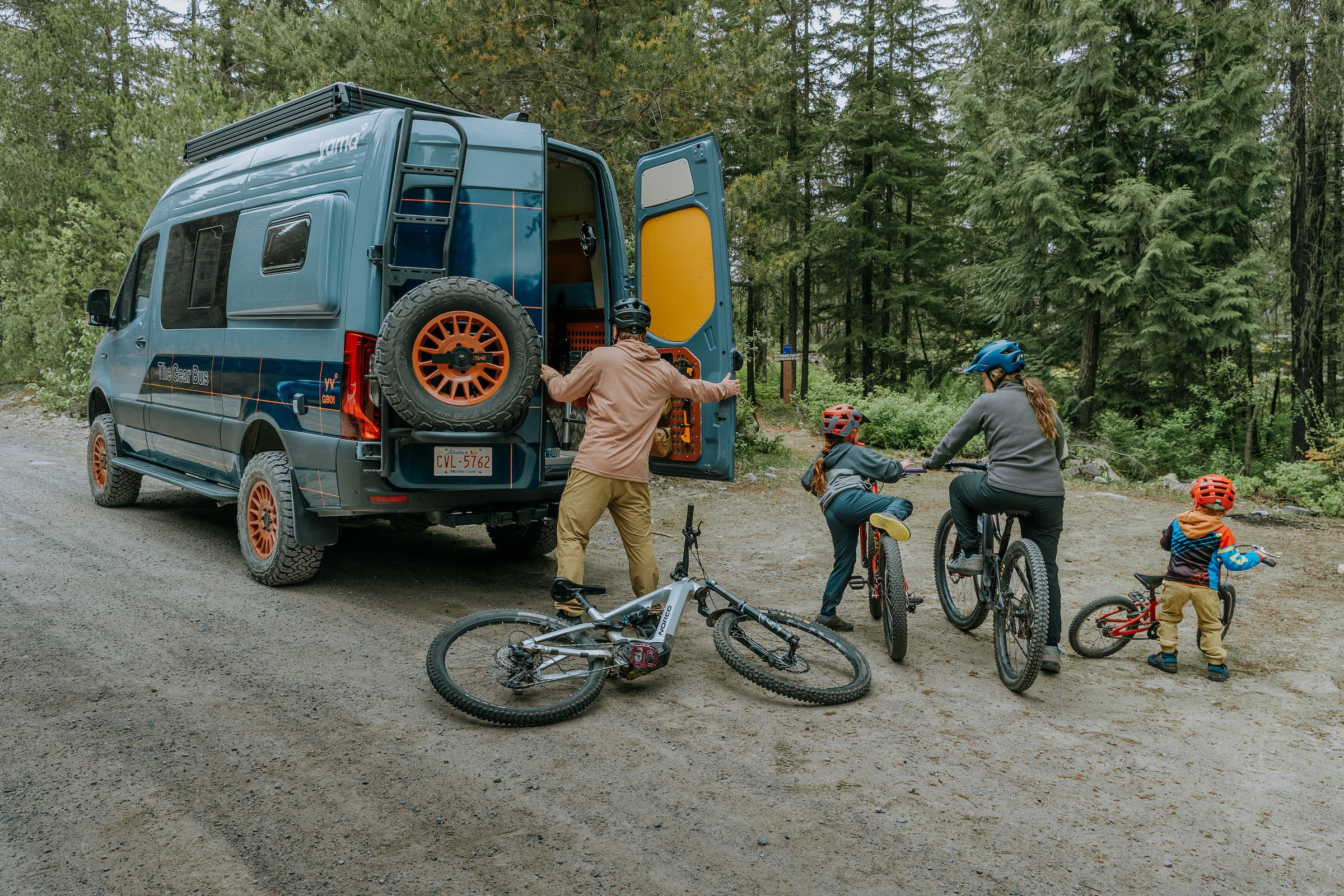
Yes – every Yama Van includes a dedicated gear garage ranging from 85 to 100 ft³, built for family-sized gear loads. Families hauling the most gear tend to gravitate toward the Gear Bus™ – Yama’s modular, minimalist build optimized for hauling more gear and people – which has the largest garage in the lineup, but even the Teton01N – one of Yama’s Signature Models, our fully-equipped builds with kitchens, bathroom facilities, and dedicated gear garages for an active lifestyle – holds plenty for most families’ gear-heavy weekends.
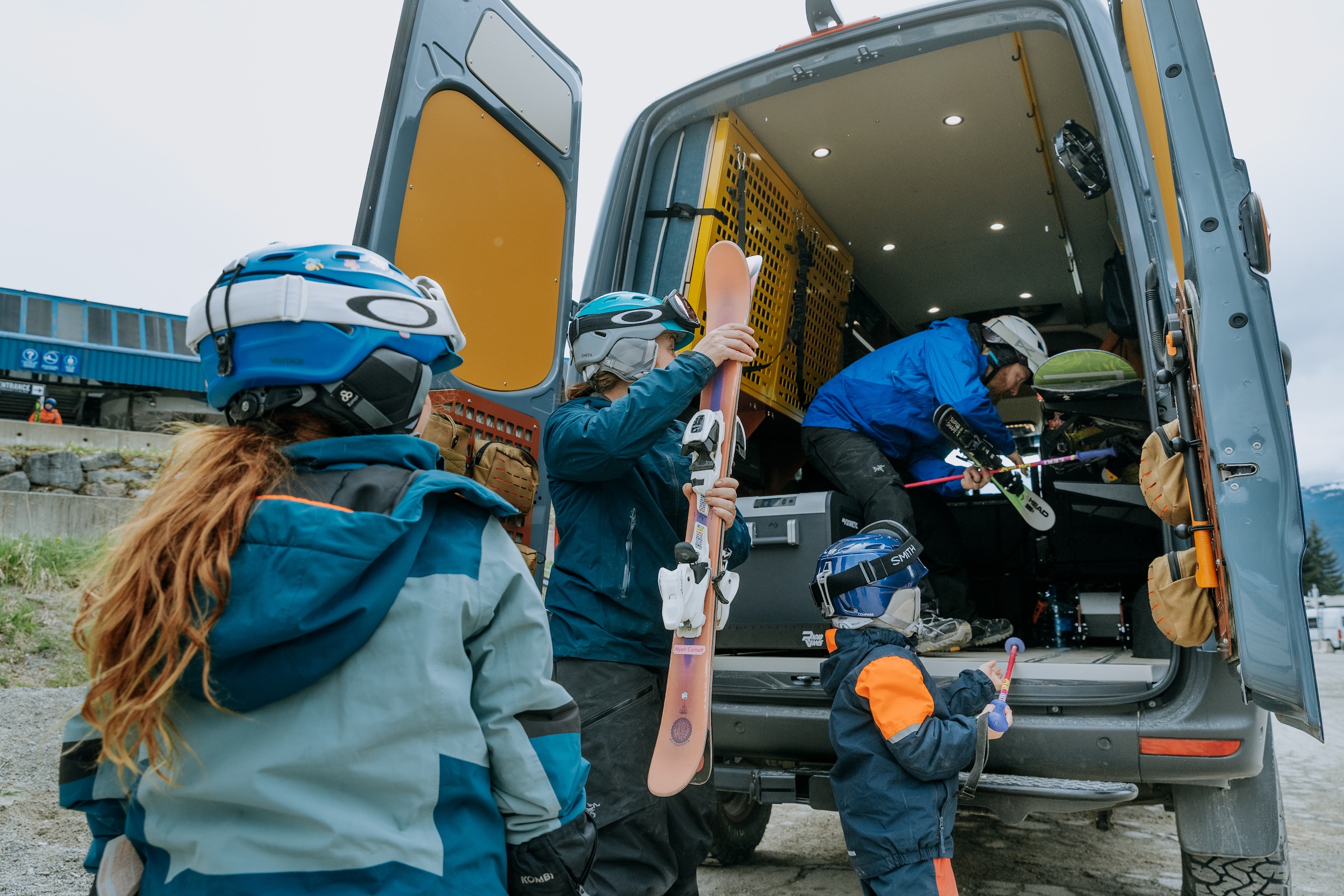
Up to four full-size bikes fit inside via fork mount with the front wheel off, protected from highway damage (exact fit depends on bike size and drop bar vs. flat bar ratio, but if two of them are kid-sized, it should be no issue). Exterior bike racks are available as an upgrade for families who’d rather keep them outside and save interior space. Skis fit vertically in the gear garage, or in an optional rear-door ski locker to keep wet gear out of the cabin.
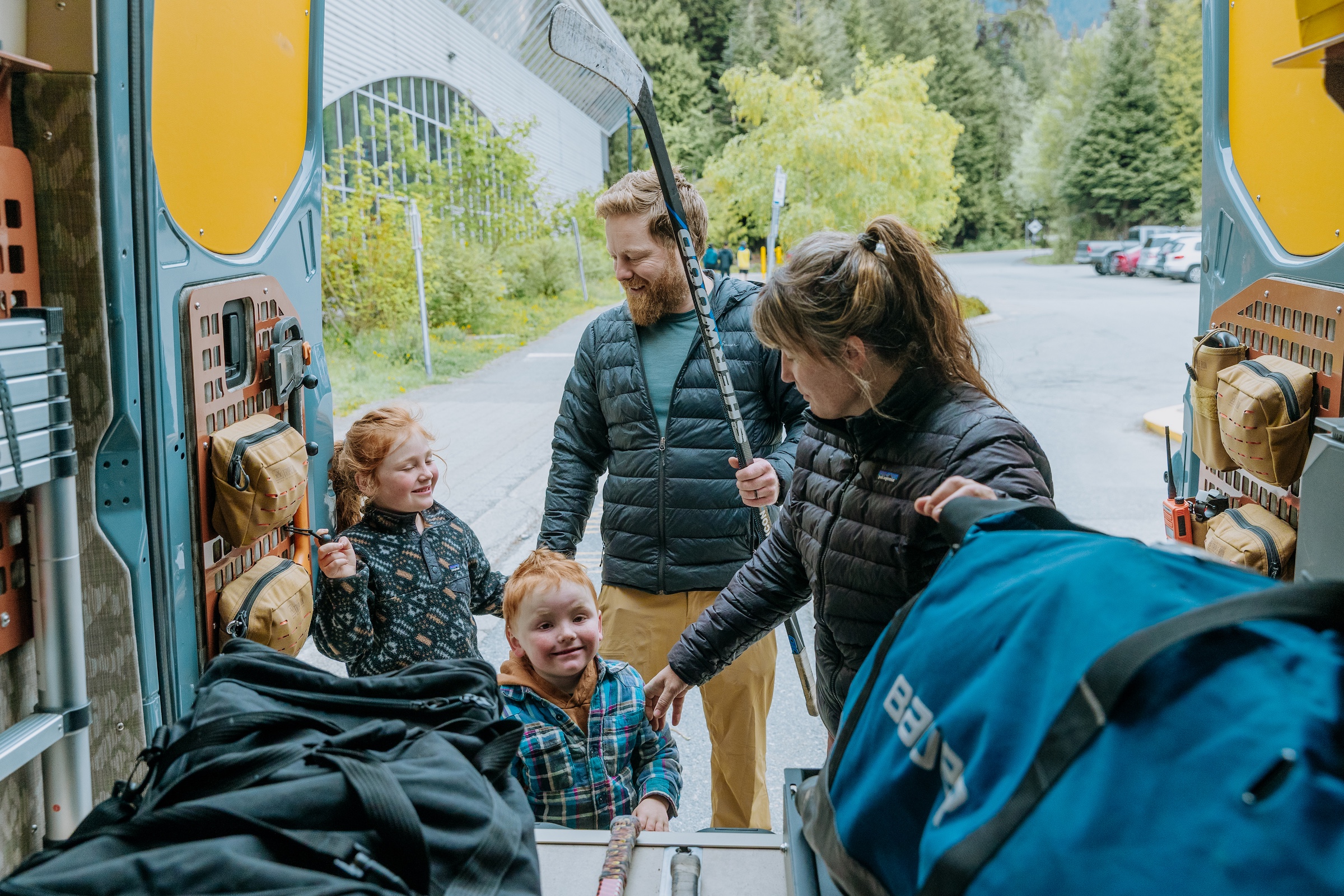
Strollers, scooters, and whatever keeps them occupied on the drive fit alongside everything else rather than competing with it, so families juggling multiple kids’ activities still have room for it all. Hockey families in particular tend to land on the Gear Bus™ – if you know, you know, the gear alone could fill a van on its own, before anyone’s even packed a bag.
How fast can we realistically set up and tear down with a toddler in tow?
Setup and teardown of your Yama Van take minutes, with no tent poles, stakes, or rainflies involved.
The Teton01N's – one of Yama’s Signature Models, our fully-equipped builds with kitchens, bathroom facilities, and dedicated gear garages for an active lifestyle – Sliding Bed System is ready almost instantly - no assembly, just a slide. The Gear Bus™ 's – Yama’s modular, minimalist build optimized for hauling more gear and people – Murphy bed takes less than five minutes to unfold. A pop-top deploys just as fast on either model: extend the ladder, climb up, and push it open, with hydraulic struts handling most of the lift. Bug screens unroll in a few seconds to keep the mosquitos out, and the awning takes a few minutes more if you want shade or shelter from the rain.
That speed matters just as much leaving as it does arriving. A toddler who’s ready for a nap doesn’t wait for a tent to dry out or a pile of stakes to get found in the grass – fold the bed, retract the pop-top, and you’re already pulling out of the site.
The Safety Stuff
Are your vans safe?
Every Yama Van is Transport Canada-certified, with standard onboard safety systems throughout.
As Western Canada’s only Transport Canada-certified Class B RV manufacturer, Yama holds the National Safety Mark (NSM) – a federal designation issued only to manufacturers who comply with the Motor Vehicle Safety Act and the Canada Motor Vehicle Safety Standards. It means every Yama Van is legally recognized as a complete, road-certified vehicle, built to the same federal safety benchmarks as any vehicle sold off a dealership lot.
Every van comes standard with a smoke and carbon monoxide detector and marine-grade wiring throughout. All aftermarket seating is crash-tested, so extra seats never mean extra risk. For an extra layer of security the optional IOPEDAL throttle tuner includes a secure mode that deactivates the gas pedal entirely – doubling as an anti-theft feature and a safety lockout when you need one.
Can we install our car seats?
Yes – all Yama Vans with rear seating are built with ISOFIX-compatible seating, so your existing car seats install the same way they would in any modern vehicle.
ISOFIX is the standardized anchor system built into most car seats and vehicles today, letting car seats click securely into place without extra adapters. In the Teton01N – one of Yama’s Signature Models, our fully-equipped builds with kitchen, bathroom facilities, and dedicated gear garages for an active lifestyle – the rear seat that doubles as a bed carries the same ISOFIX compatibility, so it functions as a proper car seat mount on driving days and folds into sleeping space once you’ve arrived.
The Gear Bus™ – Yama’s modular, minimalist build optimized for hauling more gear and people – takes it further, with up to ten ISOFIX-compatible, removable seats, so bigger families with more than two kids, or extra friends along for the ride, can install multiple car seats at once. So whether it’s one kid or three, everyone’s strapped in the way they’re supposed to be.
.png)
Is this actually going to hold up with kids? They’re going to climb on it, drop stuff, make a mess.
Yes, your Yama Van will hold up with kids. Every Yama Van is built with marine and commercial-grade materials chosen specifically for durability under hard, everyday use.
These are the same material standards used in boats and commercial vehicles, selected because they hold up to moisture, impact, and repeated wear far better than typical residential finishes. Cabinetry throughout combines lightweight aluminum with wood, balanced for both durability and everyday comfort – built to take bumps, spills, and typical wear without showing it. Countertops, flooring, and seating fabrics are chosen with the same durability-first mindset, so scuffs and marks are a wipe-down, not repair.
The honest answer: it’s not immune to a determined toddler with a permanent marker. But it’s built to the same standard as vehicles that see daily commercial abuse, so a mess from your kid is well within what it’s designed to handle.
Can we use the van in winter with our kids?
Yes – every Yama Van is built for genuine 4-season use, with heating designed to keep the whole family comfortable, even during frigid Canadian winters. We rate our vans to -15°C, though many clients have taken them out well below that with some adjusted operating procedures in extreme conditions.
Every Yama Signature Model – Yama’s fully-equipped build, including a kitchen, bathroom facilities, and a dedicated gear garage – includes our signature 21k BTU hydronic heating system, delivering heat through cabin air, on-demand hot water, and radiant in-floor warmth, running quietly and efficiently in the coldest conditions. The fresh water tank and house batteries are also insulated and heated to keep your systems running when the temperature drops.
The Gear Bus™ – Yama’s modular, minimalist build optimized for hauling more gear and people – uses a 7500 BTU diesel air heater to keep you toasty. All Yama models include insulated window coverings to keep warmth in, and iIf you’re planning to ski all winter, we’d recommend adding an insulated cab curtain for even better heat retention between the cab and the living area – it keeps where the heat you need it most. No missing first chair because the little ones (or you) were too cold to get out of bed.
The Practical Stuff
Is this actually easier than what we’re doing now? Is a van a better option than a cabin/vacation property for easier family trips?
In our humble opinion, yes to both – a Yama Van removes the packing and planning friction of traditional camping, while offering more flexibility than a fixed vacation property.
Compared to tenting or a traditional trailer, the biggest shift is what disappears: no tent poles, no propane, no cooler that needs re-icing every two days, and less stress. Setup and teardown take minutes, the kitchen and bathroom travel with you, and gear stays packed between trips instead of getting re-loaded each time. With a Yama Van, the choice to go isn’t weighed down by the effort of going.
Compared to a cabin or vacation property, the tradeoff is mobility versus fixed location. A cabin ties your family to one place, one drive, one view, trip after trip – and for some families, that’s exactly the point. Some of our clients even use a Gear Bus™ to get there, packed with gear for the whole extended stay. But for some families who would rather not commit to one spot, a Yama Van goes wherever the weekend calls for instead. For families whose idea of a good trip changes with the season, that flexibility often does more work than a fixed address ever could.
What financing options are there, and what’s a realistic all-in budget for a family build?
Pricing starts at $103,000 CAD for a Gear Bus™ — Yama's modular, minimalist build optimized for hauling more gear and people — and between $209,000 and $243,000 CAD for our Signature Models, which add kitchens, bathroom facilities, and dedicated gear garages for off-grid, active-lifestyle travel – with your all-in cost shaped by which upgrades make sense for your family. This pricing covers the conversion itself and doesn’t include the Mercedes-Benz Sprinter chassis, which runs an additional cost of roughly $100,000 CAD, purchased separately.
Financing is available through third-party partners, with terms up to 20 years – closer to a mortgage than a typical vehicle loan. A 10% down payment is typical, though your actual monthly payment will vary based on interest rates and credit qualifications.
.png)
We’re not van/camping experts - how much guidance will you give us through the decision?
A lot – Yama is with you every step of the way, from your first consultation through delivery and beyond, so you don’t need to already know your way around a van to get this right
Families in this chapter tend to move faster than other buyers, often deciding within a few months, rather than afteryears of research, so that guidance starts early with our co-design process – a structured, collaborative approach that gets every detail dialed in before a single bolt turns. Our team walks you through model differences in plain language, helps you prioritize upgrades based on how your family actually plans to use the van, and works with you to create a finish that reflects your family’s style.
Before we hand you the keys, we spend a couple of hours making sure you know the van inside and out, every system, every detail, until you feel ready to roll. Then, when you drive away in your Yama Van, you’re backed by a dedicated service team who knows your build inside and out. Whether it’s troubleshooting, repairs, upgrades, or tune-ups, they’re just a call or a click away.
What can we expect for resale value?
Like any vehicle, a Yama Van sees its steepest depreciation when it’s driven off the lot. On average to date, Yama Vans depreciate 8-12% annually, though resale value depends on age, mileage, and condition. .
When that time comes, whether your family’s outgrown the van or you’re ready for the next adventure, Yama’s Pre-Loved Program means you’re not navigating the process alone. We take the hassle out of selling by marketing your van through our own channels, vetting prospective buyers, and connecting you directly – so you’re not fielding calls from tirekickers.
Yama markets your van through its own channels, vets prospective buyers, and connects you directly, so you're not fielding calls from tirekickers. And if you’re moving onto your next Yama Van, we’ll apply 50% of the commission to your next build.
If you’re still working through how a Yama Van might fit your specific chapter, that’s exactly what our Intro Calls are for – an honest conversation with someone who knows these vans inside and out.
.jpeg)
Rebecca Casey
Marketing & Events Specialist at Yama Vans


.png)